Tavex uses cookies to improve the user experience on the site. Read about Tavex’s cookie policy here. You can accept them all or manage them in the settings.
Please select what cookies you allow us to use
Cookie usage
Here you can find all the cookies that might be stored on your browser while browsing the site, what they are used for, and for how long at most each one of them is remembered.
Preference
| Cookie name | Description | Duration |
|---|---|---|
| catalog_view | How are products listed? | 1 year |
Marketing
| Cookie name | Description | Duration |
|---|---|---|
| ga_id | Google Analytics ID | 1 year |


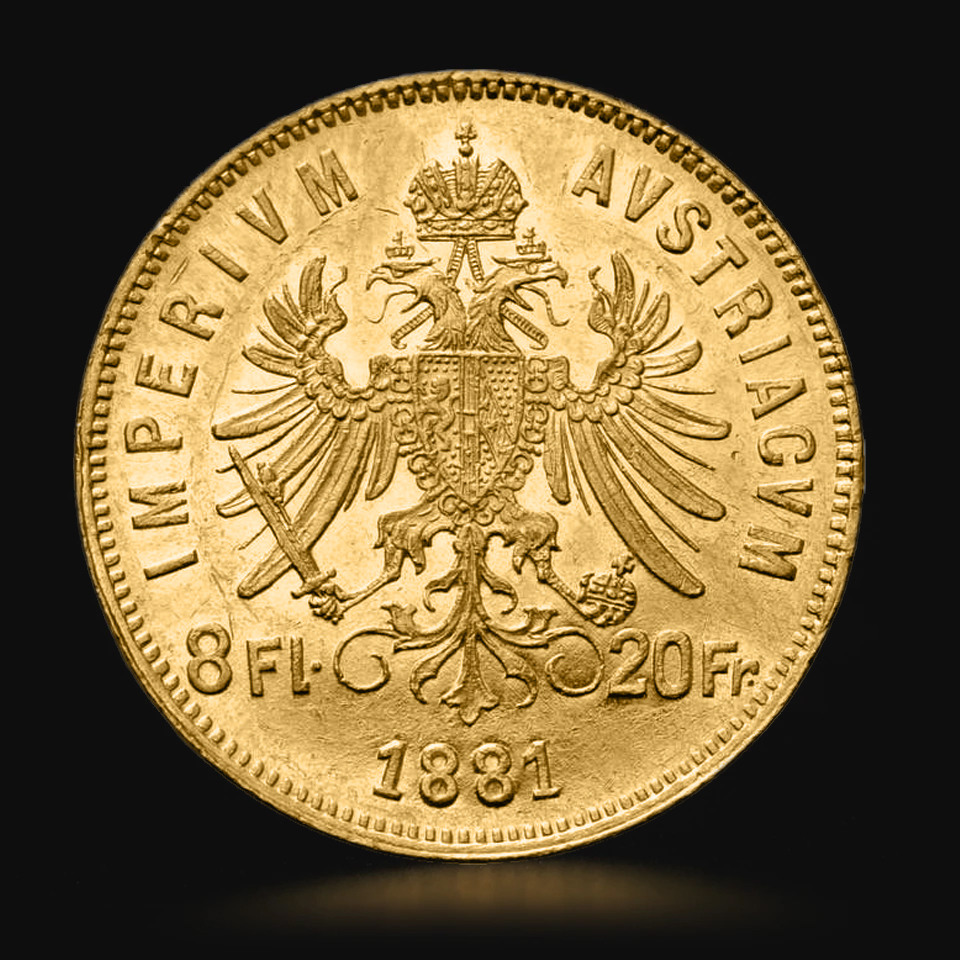
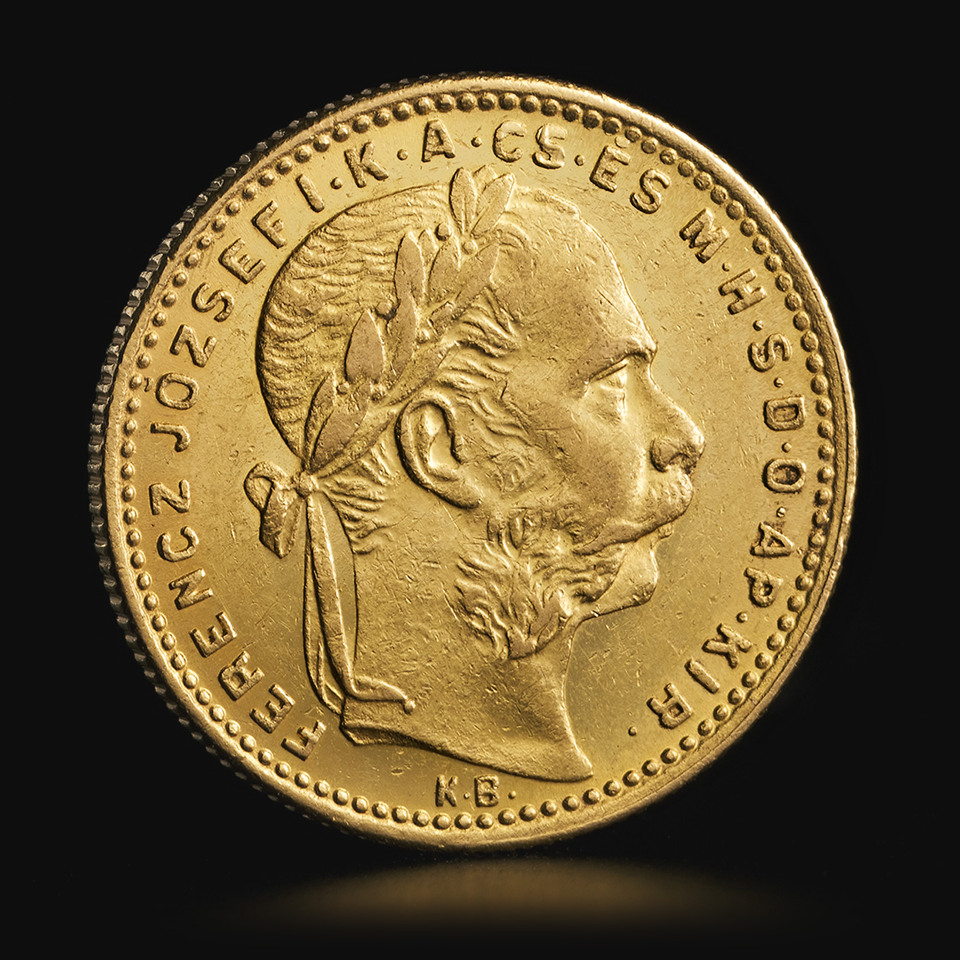
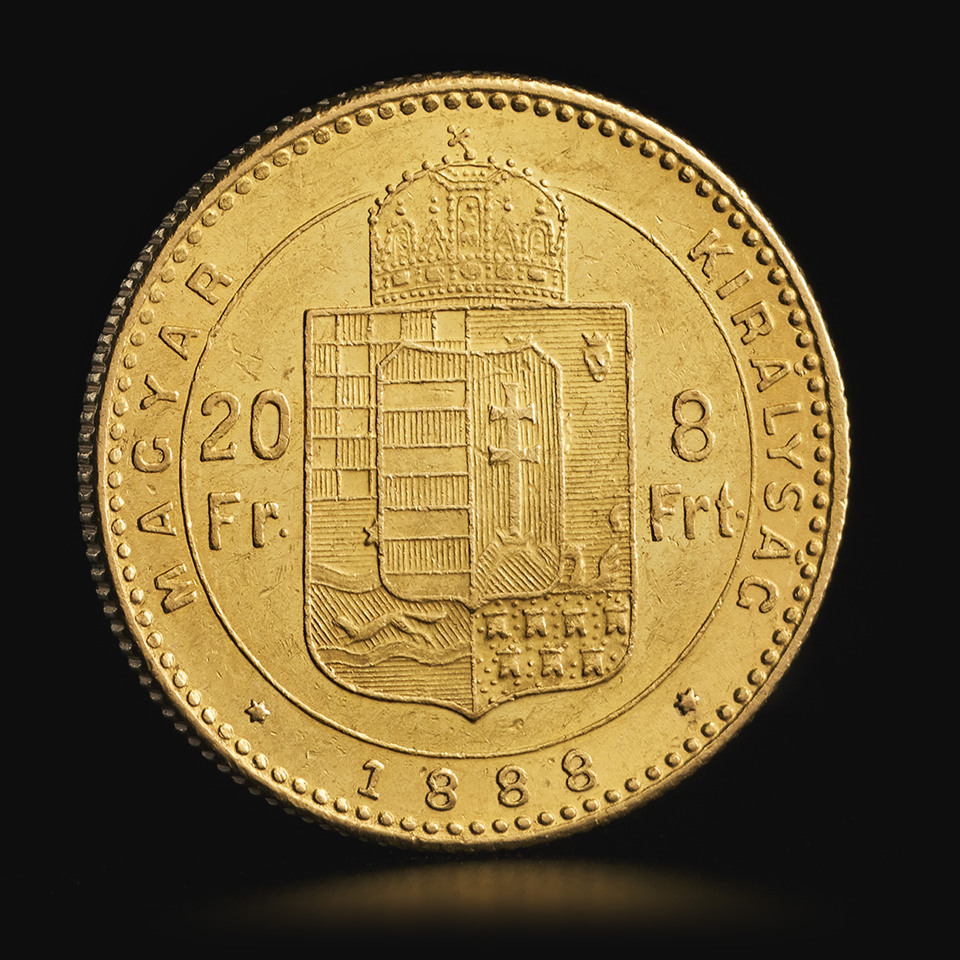


The photos are used for illustration purposes only and may not be an exact representation of the product.
Hungarian Franz Joseph 20 Franc/8 Forint
In StockHungary’s most distinguished classic gold coin, the Franz Joseph 20 franc / 8 forint coin, is an ... read more
We sell
We buy
Spread
4321 lei
Weight
5.81 g
Quantity
Price
4321 lei
Transaction details
This option allows you to sell gold remotely. How it works:
- Make sure you have selected the correct item.
- Complete the selling application for selling remotly.
- Follow the instructions received by email.
Warning! Make sure the products are properly packed for shipping. Tavex assumes no responsibility for loss, damage or other costs related to the package until it is received safely.
If you have any further questions, please contact us at: 0756 541 896 or rascumparare@tavex.ro

We buy
3572lei
Total expected value
3572lei
The amount displayed is estimated and is based on the data entered. The final price will be confirmed after the evaluation of the products by a Tavex specialist.
Customers rating for Tavex
Introduction
Hungary’s most distinguished classic gold coin, the Franz Joseph 20 franc / 8 forint coin, is an intriguing gold piece carrying two different denominations that are testimony to Hungary’s long and varied monetary tradition. Also referred to as the “Hungarian 8 forint” or the “Hungarian 20 franc”, it embodies the history of the Austro-Hungarian Empire, the second largest European nation and one of the world’s leading powers of the time. The past is immortalised in a 21.6 karat gold alloy that was crafted in accordance with Europe’s first major currency union, the Latin Monetary Union. The 20 franc / 8 forint gold coin is embellished with the royal arms of Hungary, and the effigy of one of the last great monarchs of Europe, Franz Joseph of Austria. Issued between 1870 and 1892 by the Kremnica Mint, which today holds the title of one of the oldest mints in the world, the Hungarian 20 franc / 8 forint is of historical significance, making it suitable for collectors and investors who wish to possess a tangible and valuable gold coin.
Why Buy
- The 20 franc / 8 forint gold coins are remnants of Hungary’s glorious past. Embellished with the Hungarian royal arms, and showing peerless uniformity by adhering to the two denominations that grace the coin’s surface, they are especially famous throughout Central Europe.
- Hungarian 20 francs / 8 forint are well suited for coin collections. This coin embodies the history of two great former European realms, the Kingdom of Hungary and the Austro-Hungarian Empire, and portrays one of the leading monarchs of the time, Emperor Franz Joseph. The Hungarian 20 franc / 8 forint s gold coin is packed with history and will thus make a great addition to any coin collection.
- Hungarian 20 francs / 8 forint are money. Hungarian 20 franc / 8 forint s are exempt from Value Added Tax, and are exchangeable throughout Europe by bullion dealers and investors alike.
- Hungarian 20 francs / 8 forint are the equivalent of savings. Hungarian 20 franc / 8 forint s are an ideal choice for any long-term saver who appreciates the security and stability of owning physical gold coins.
- The 20 franc / 8 forint coins track the price of gold. The base value of these gold coins is primarily determined by their fine gold content which is linked to the prevailing price of gold.
History
The history of the Hungarian forint
To better appreciate the Hungarian 20 franc / 8 forint gold coin, one most delve into the part of Hungary’s striking history when King Charles I transformed the Kingdom of Hungary into a great power. Already a significant nation during the early second millennium, Hungary would in the 14th century under the reign of King Charles I become, geographically speaking, the second biggest kingdom in Europe. At its peak, the Kingdom of Hungary stretched from along the Adriatic coast in the west, to the Balkan mountain range in the south, encompassing most of Transylvania in the east, which today is considered part of Romania, and laying claim to the Carpathian Mountains in the north. In other words, Hungary today is only a shadow of its former glorious self.
Charles I, also referred to as Charles Robert, descending from both Italian and Hungarian royalty, laid claimed to the Hungarian throne in the early 1300s. His rule saw the Kingdom of Hungary rise both territorially and economically, establishing itself as one of the foremost countries in Europe. How did he accomplish this? Well, his political and military skills surely helped along the way, but the primary source of his power that enabled him to reign effectively and successfully was gold, and lots of it.
Around the time of his rule, rich gold deposits had been uncovered and were being mined in the mountainous region in what today would be considered central Slovakia. These mines were so rich in the precious metal that the Kingdom of Hungary became Europe’s biggest and one of the leading gold producers in the world. The steady stream of precious metal flowing into the treasury coffers greatly enhanced Charles’s ability to govern. However, the wealth from the mountains would not have contributed to the prosperity of the kingdom as a whole had it not been for Charles’ reform of the country’s monetary system that laid the foundation for the Hungarian gold forint coin.
Witnessing the success of the florin, a 24-karat gold coin minted by the Italian city-state of Florence that dominated European trade at the time, Charles introduced a similar coinage that shared the same uniformity with regard to weight and purity, albeit with a slightly different design. The new gold coinage was in Hungary referred to as “florentinus”, which was eventually shortened to “forint”, hence the name of the denomination depicted on the Hungarian 20 franc / 8 forint gold coin.
To mint the new coinage, Charles granted Kremnica, a major mining town near the abundant gold deposits, royal privileges to set up a mint that would produce the gold forints. The mint began to transform the gold ore into forint coinage that was subsequently distributed throughout the kingdom. Because of Charles’ pledge to keep the uniformity of the gold forint stable, inflation, which had previously been wreaking havoc with the economy, was brought under control. The integrity of the forint also contributed to boosting trade, which quickly picked up as a result of the more convenient and safe way of transacting. This led to an improved fiscal situation for many towns and municipalities, which also benefited the royal coffers through higher tax receipts. Besides helping to grow and enrich the kingdom, the gold forint would become a regional currency of choice for the settling of payments.
The Kremnica Mint that Charles had commissioned to mint the gold forint would outlive Charles, becoming the region’s most important producer of precious metal coinage that, besides striking forints, would be responsible for minting many of Europe’s most famous gold coins, one of them being the ducat. In fact, the Kremnica Mint is today still running, which makes it one of the oldest continuously producing mints in the world.
The founding of the Hungarian 20 franc / 8 forint gold coin
The Kingdom of Hungary was in the next couple of centuries slowly assimilated into the domain of the Habsburg Emperors, at that time one of the most powerful royal families in Europe, and would be part of the Austrian Empire by the early 1800s. Following Austria’s defeat in the Austro-Prussian war in 1867, Hungarian nationalists exploited Austria’s weakened political position and secured partial independence for Hungary, one that gave it full autonomy of its domestic affairs, but which shared a common foreign policy with Austria, thus establishing the dual monarchy referred to as the Austro-Hungarian Empire.
Once again in control of its monetary affairs, Hungary introduced the 20 franc / 8 forint gold coinage in 1870. The reason why the new gold coins depicted the denomination of 20 francs was that Austria had three years previously made a treaty with France to become a member of the Latin Monetary Union, which then naturally applied to Hungary as well.
This monetary union was originally founded in 1865 by Italy, France, Belgium and Switzerland, and was an attempt to unify the respective countries’ money into a single uniform currency. The founding members of the union agreed on a uniform fineness and weight of their coinage, which was set to equal the French silver and gold franc, and they agreed to interchange each other’s gold and silver coinage at parity, irrespective of whether it carried another design, effigy or name. This standardisation facilitated and simplified trade among the member countries and was seen as an appealing concept, leading Austria and Hungary to join.
Hungarian 20 franc / 8 forint gold coins facilitated daily trade in the Austro-Hungarian Empire
After the 1870s and leading up to World War I, the Austro-Hungarian Empire prospered. Industry expanded, artistic and scientific segments of society were thriving, the infrastructure was being modernised, railway networks, river channels and ports were being constructed throughout the dual monarchy, Hungary became a leading source of food for the rest of Europe, and the Empire as a whole became the world’s fourth largest machine manufacturer. It was a dynamic economy in which the Hungarian 20 franc / 8 forint coin played an important part by facilitating day-to-day commerce. With incomes rising and trade flourishing, the ruling Emperor of that time, Franz Joseph (who is depicted on this coin), became naturally associated with a time of “plenty”, boosting his popularity as a consequence. He drew a strong loyal following in Hungary, especially considering his pacifist approach towards Hungary that included granting the country autonomous rule.
Product weight in grams
6.4516
Gold weight in grams
5.80644
Fineness
900
Gold weight in troy ounces
0.18668
Diameter
21
Thickness
-
Face value description
8 forints/ 20 francs
Manufacturer
Austrian Mint, Austria
Obverse
The obverse portrays the effigy of Emperor Franz Joseph crowned with a laurel. The title “FERENCZ JOZSEF I K A CS ES M H S D O AP KIR”, which translates as “Franz Joseph I, by the grace of God, Emperor of Austria and Apostolic King of Hungary, Croatia, Slavonia, Dalmatia”, surrounds his portrait. On the king’s neckline is the mark of Kremnica Mint “K.B.”.
Reverse
The reverse displays the royal arms of the Kingdom of Hungary surrounded by the text “MAGYAR KIRALYSAG”, which translates as “Hungarian Kingdom”, and with the denomination “20 Fr” to the left and “8 Frt” to the right. At the bottom is the year of mintage.
Packaging
Each coin is individually packaged in a hard plastic capsule if desired.
NB! Some of the historical coins might be restrike versions.
Delivery
When you place an order through our online store, you can choose to have your products delivered by FAN Courier or to pick them up in person at one of our offices in Bucharest or Cluj.
Delivery by FAN Courier: after we have received and confirmed your payment, the products will be shipped within 24 hours. The delivery time is within 1-5 business days. FAN Courier will contact you by phone.
Pick-up from Tavex offices: you are welcome to come and collect your products at one of our offices in Bucharest or Cluj, on the same day we have received your payment.
In both cases, you must bring a valid ID to collect the products. Please note that the payer, customer and recipient must be the same person.
Insurance
The package is fully insured and, in the extremely unlikely event that the package is lost or damaged, we will resend the items or refund your money.
Packaging
Products are wrapped in protective packaging and placed in a discreet, unbranded package.
Shipment Tracking
Once the products have been packaged and dispatched, you will receive instructions and a code to track the shipment.
Delays
In the event of a delay in delivery, or if the product you ordered is out of stock, we will always contact you by email to provide you with delivery details.

Shipping Cost
Tavex provides fast, easy and secure shipping for all orders placed online. For orders with a total value of over 100 lei, shipping is free.
High stock availability
Most Tavex products are always in stock and therefore Tavex can deliver quickly and pick up on the same day at top prices on the market. Tavex is the official partner of the world’s largest mints, such as Perth Mint Australia, Austrian Mint (Münze Österreich), China Great Wall Coins Investments Ltd., PAMP Suisse and Valcambi refineries – market leaders in gold bullion production – but also of many other gold refineries and dealers.
Same-day product pickup
You can visit of our offices to benefit from a free consultation or to find out more details about a specific product. If you purchase online, you can pick up your purchased products on the same day that the payment is processed.
Low prices
Thanks to over 25 years of experience and large transaction volumes, Tavex can offer you the best prices on the market. At the same time, you can maximize your return on investment due to the low margins and spreads operated by Tavex.