Tavex uses cookies to improve the user experience on the site. Read about Tavex’s cookie policy here. You can accept them all or manage them in the settings.
Please select what cookies you allow us to use
Cookie usage
Here you can find all the cookies that might be stored on your browser while browsing the site, what they are used for, and for how long at most each one of them is remembered.
Preference
| Cookie name | Description | Duration |
|---|---|---|
| catalog_view | How are products listed? | 1 year |
Marketing
| Cookie name | Description | Duration |
|---|---|---|
| ga_id | Google Analytics ID | 1 year |




The photos are used for illustration purposes only and may not be an exact representation of the product.
French 20 Francs Angel (Genius) Gold Coin
In StockTavex is pleased to present a European classic, the eminent French 20 Franc Angel gold coin, also ... read more
We sell
We buy
Spread
4246 lei
Weight
5.81 g
Quantity
Price
4246 lei
Transaction details
This option allows you to sell gold remotely. How it works:
- Make sure you have selected the correct item.
- Complete the selling application for selling remotly.
- Follow the instructions received by email.
Warning! Make sure the products are properly packed for shipping. Tavex assumes no responsibility for loss, damage or other costs related to the package until it is received safely.
If you have any further questions, please contact us at: 0756 541 896 or rascumparare@tavex.ro

We buy
3572lei
Total expected value
3572lei
The amount displayed is estimated and is based on the data entered. The final price will be confirmed after the evaluation of the products by a Tavex specialist.
Customers rating for Tavex
Introduction
Tavex is pleased to present a European classic, the eminent French 20 Franc Angel gold coin, also referred to as the “20 Franc Lucky Angel” or the “20 Franc Genius”. With a rich history of more than 600 years, the 20 franc gold coin recalls France’s former eminence as one of the great powers of the 19th and 20th centuries. Standardised and authorised by Napoleon Bonaparte himself, the 20 franc is France’s most treasured and sought-after gold coin. Displaying perfect uniformity and accuracy for over a century, French 20 francs facilitated world trade and became the basis for Europe’s first monetary union. With more than 500 million pieces minted since the 1800s, they are today one of the most liquid and widely recognised historical gold coins available on the European bullion market. Beautifully designed and representing a charming and glamorous aspect of French culture, the 20 franc angel gold coin comes in an affordable weight, making it appropriate as a collector’s item, a gift, or a tangible gold investment.
Why Buy
- 20 franc Angel gold coins are distinguished French coins. The 20 franc Angel gold piece is one of France’s most famous coins and likewise one of the most best-known gold coins in Europe because of its rich folklore.
- 20 franc Angel gold coins are money. They are exempt from Value Added Tax, and are as such exchangeable throughout Europe by bullion dealers and investors alike.
- 20 franc Angel gold coins are liquid. With more than 75 million pieces minted since in 1871-1898, French 20 franc Angel gold coins have strong liquidity and a guaranteed market.
- 20 franc gold coins were the foundation of Europe’s first monetary union. The French 20 franc gold coins were the basis for the Latin Monetary Union, Europe’s first major currency union.
- 20 franc Angel gold coins are an excellent way to diversify your portfolio. Gold’s low correlation with other financial assets makes French 20 franc Angel gold coins serve as a portfolio hedge against market risk.
- 20 franc Angel gold coins are the equivalent of savings. French 20 franc gold coins are an ideal choice for any long-term saver who appreciates the security and stability of owning physical gold coins
History
An angel depicted on the French 20 franc gold coin
The design of the reverse side of this coin was created in 1791 by renowned French engraver Augustin Dupré. The motif of the portrayed “angel” is sometimes also referred to as “lucky angel”, “genius of freedom”, or “the guardian angel Genius of France”. The reason for the multiple names is because of the coin’s rich folklore and the uncertain interpretation of Dupré’s artwork. When the ruling aristocratic dynasty was deposed during the French revolution in 1789, new coinage was needed to proclaim the new order. This gave artists and engravers much more creative freedom, since the former coinage most often depicted the effigy of the ruler. Dupré, whose work was inspired by the symbolism of antiquity, won the design competition for the new currency.
It is believed that the “angel” Dupré designed is a “genius”, an ancient symbol of divinity which derives from Roman religion, in which it was believed that every human being, or a collective thing (humans, nature, animals), possessed a divine essence, or a soul. The depicted “genius” on the reverse of the new 20 franc gold coin could have been Dupré’s way of symbolising the “soul, or spirit of the French Revolution”.
However, reference to the depicted “genius” as “angel” came to life when a story about how Augustin Dupré himself escaped execution in the Reign of Terror, a period of violence that followed the French Revolution, because the “angel coins” he carried in his pocket protected him against harm. The designer was sentenced to lose his head on the guillotine during the French Revolution. According to legend, however, Dupré was able to bribe his guard with the Angel coin he carried in his pocket and made his escape. The story kept on being told over the years, building the legend of the coin’s “good luck” aura. The legend of the coin’s attributed powers became so pronounced that it changed the world history. It is said that Napoleon Bonaparte always carried an early French Angel in his pocket until losing it the night before the fateful Battle at Waterloo. This battle marked the beginning of his downfall.
Although none of these assertions is certain, what is definitely true is that the 20 franc Angel’s beautiful and mystical design has contributed to making it one of the most recognised and sought-after gold coins of the Napoleon series. The French 20 franc Angel gold coin was issued during three different periods: 1848-1849, 1871-1898, and 1899-1906.
The origin of the French gold franc
The fascinating history of the gold franc began in the 14th century during the Hundred Years’ War. This was the time of a series of waged conflicts between France and Britain, and during the Battle of Poitiers in 1356, in France, the French King John II was captured by his English foes. The English sought a ransom for the French king, three million gold coins to be exact. Once the terms were agreed upon, King John was released, and his return from captivity was glorified with the introduction of a gold coin called the franc à cheval, meaning “free on horse”, alluding to how the King rode out as a free man. Although the new gold franc was thereafter used in trade throughout France, its uniformity was often subject to revaluation. This changed when Napoleon Bonaparte came to power at the beginning of the 1800s.
The French 20 franc gold coin was authorised by Napoleon Bonaparte
Considered one of the world’s foremost military leaders, Napoleon Bonaparte, highly skilled in politics, managed during the end of the French revolution to assert himself as the First Consul of the new French government. A staunch proponent of gold, he authorised the standardisation and creation of the Napoleon gold coin in 1803. The new coin was originally minted in two denominations, 20 and 40 francs. Denominations of 5, 10, 50 and 100 francs were later introduced and minted at various times, but the most popular and consequently most minted was the 20 franc gold coin. The 20 franc Napoleon gold coin weighed 6.45 grams, and contained 90% gold, or 5.805 grams of gold. The 20 franc gold coin was last issued in 1914, and although the design and the depicted effigy changed during this period, the coin’s denomination and uniformity stayed the same, contributing to the coin’s reputation and popularity as a trustworthy and accurate gold coin. Consequently, all 20 franc gold coins minted in the 19th and 20th centuries are referred to as “Napoleons”.
The French 20 franc coin - the gold standard of Europe
Ironically, Napoleon’s 20 franc gold coin was more successful in unifying Europe in terms of coinage, and consequently trade and prosperity, than what Napoleon sought to accomplish by force. And while the territories Napoleon had conquered were soon lost, the 20 franc gold coin did just the opposite. It prevailed and established itself as the foundation of Europe’s first major currency union under the name “Latin Monetary Union”. The Union was originally formed in 1865 between France, Belgium, Italy and Switzerland, and was an attempt to unify those countries’ money into a uniform single currency. The French gold franc’s peerless uniformity and the attractiveness of the relatively large French economy provided the incentive and the foundation for a new “euro” currency.
The founding members of the union adopted the franc and they agreed to freely interchange each other’s gold and silver coinage at parity, irrespective of whether they carried another design or motif. The ratio of the two precious metals was likewise standardised, with 4.5 grams of silver being equal to .290322 grams of gold, a ratio of 15.5 to 1. The standardisation facilitated and simplified trade among the member countries and was seen as an appealing concept, leading other European countries to join as well. Although the union came with numerous flaws, one of them being that individual governments over-issued paper notes above the stipulated fixed ratio that was set between paper notes and circulating precious metal coinage, they were all the consequence of poor human judgement rather than the failure of the uniform precious metal coinage itself. Nevertheless, the union expanded until the advent of World War I, and came to a formal end a decade later in 1927.
The popularity of French 20 franc gold coins lives on
Napoleon gold coins were widely distributed during the 19th and 20th centuries in Europe and throughout the world. France controlled a large part of Europe in the early 1800s and subsequently rose to its colonial might in the early 20th century. To facilitate trade and investments, the Napoleon 20 franc gold coins became the preferred choice due to their stable uniformity and trustworthiness. Most of the Napoleon gold coins were issued after the 1850s, which coincided with the expansion of the Latin Monetary Union and the height of the French colonial empire. The production of the Napoleon series ended by the early 1900s with the last version being the 20 franc Rooster gold coin. Although Napoleon gold coins are no longer produced, their popularity lives on, and they are in fact today the most traded classic gold coins in several European countries, including France.
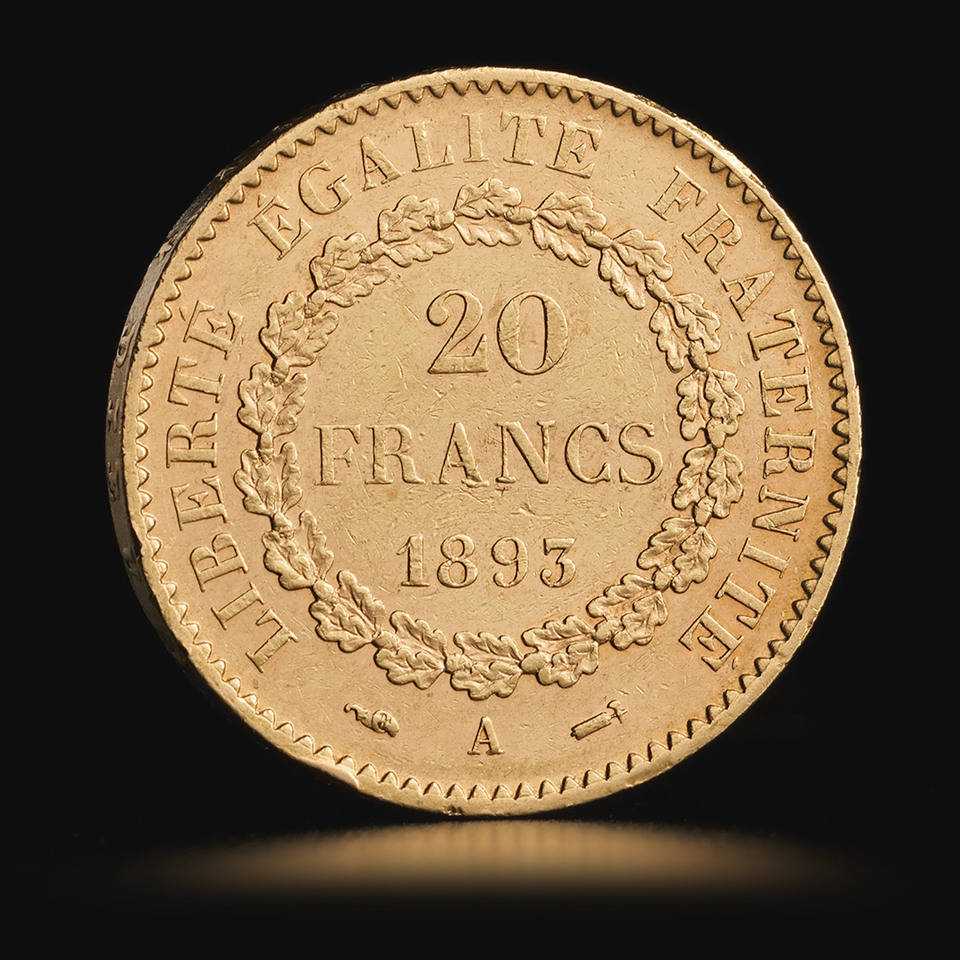
As the French empire expanded, the need for gold and silver coinage increased. To satisfy the vast demand, gold francs were minted in several mints, and, over the years thatNapoleon gold coins were issued, more than twenty French mints, but also mints in countries under French rule, produced these desired gold coins. Every mint that struck gold francswas obligated to leave a unique identification mark on every coin so that the origin of the gold franc would be more easily traceable. The mark could either be a letter, a symbol, or a monogram. For instances, the letter “A” corresponded to the Paris mint, while the letter R, or the symbol of a crown, was the mark of the Rome mint. Although the production of gold francswas widespread throughout France and Europe, the large majority of these gold coins were minted by the Monnaie de Paris. Founded in 864 by the French King Charles the Bald, the Monnaie de Paris is the largest and oldest mint in France and likewise the oldest French institution. Even though the mint was a government institution and was responsible for the mintage of French circulating coinage, it shared this responsibility for almost a millennium with other French mints, hence the many different mint markings on the Napoleon gold coin.
In 1878, the Paris mint was granted exclusive privilege to be the only French mint to produce circulating coinage and is today the country’s main mint and sole producer of the official French euro coinage.
Product weight in grams
6.4516
Gold weight in grams
5.80644
Fineness
900
Gold weight in troy ounces
0.18668
Diameter
21
Thickness
-
Face value description
20 franc
Manufacturer
France
Obverse
The obverse portrays the motif of a standing angel on pedestal. The angel is inscribing the French constitution upon a tablet which is posed on a column. Surrounding the angel is the text “REPUBLIQUE FRANCAISE”. To the left of the angel is the hand of Justice, or fasces lictoriae, and to the right is a rooster. Under the angel is the signature of the master engraver “DUPRÉ”
Reverse
The reverse contains in the centre the denomination of 20 FRANCS and the year of mintage, encircled by a wreath of oak leaves, and the text “LIBERTE EGALITE FRATERNITE”, which translates as “Liberty, Equality, Fraternity”. Under the wreath is the mint mark.
Packaging
Each coin is individually packaged in a hard plastic capsule if desired.
NB! Some of the historical coins might be restrike versions.
Delivery
When you place an order through our online store, you can choose to have your products delivered by FAN Courier or to pick them up in person at one of our offices in Bucharest or Cluj.
Delivery by FAN Courier: after we have received and confirmed your payment, the products will be shipped within 24 hours. The delivery time is within 1-5 business days. FAN Courier will contact you by phone.
Pick-up from Tavex offices: you are welcome to come and collect your products at one of our offices in Bucharest or Cluj, on the same day we have received your payment.
In both cases, you must bring a valid ID to collect the products. Please note that the payer, customer and recipient must be the same person.
Insurance
The package is fully insured and, in the extremely unlikely event that the package is lost or damaged, we will resend the items or refund your money.
Packaging
Products are wrapped in protective packaging and placed in a discreet, unbranded package.
Shipment Tracking
Once the products have been packaged and dispatched, you will receive instructions and a code to track the shipment.
Delays
In the event of a delay in delivery, or if the product you ordered is out of stock, we will always contact you by email to provide you with delivery details.

Shipping Cost
Tavex provides fast, easy and secure shipping for all orders placed online. For orders with a total value of over 100 lei, shipping is free.
High stock availability
Most Tavex products are always in stock and therefore Tavex can deliver quickly and pick up on the same day at top prices on the market. Tavex is the official partner of the world’s largest mints, such as Perth Mint Australia, Austrian Mint (Münze Österreich), China Great Wall Coins Investments Ltd., PAMP Suisse and Valcambi refineries – market leaders in gold bullion production – but also of many other gold refineries and dealers.
Same-day product pickup
You can visit of our offices to benefit from a free consultation or to find out more details about a specific product. If you purchase online, you can pick up your purchased products on the same day that the payment is processed.
Low prices
Thanks to over 25 years of experience and large transaction volumes, Tavex can offer you the best prices on the market. At the same time, you can maximize your return on investment due to the low margins and spreads operated by Tavex.