Tavex uses cookies to improve the user experience on the site. Read about Tavex’s cookie policy here. You can accept them all or manage them in the settings.
Please select what cookies you allow us to use
Cookie usage
Here you can find all the cookies that might be stored on your browser while browsing the site, what they are used for, and for how long at most each one of them is remembered.
Preference
| Cookie name | Description | Duration |
|---|---|---|
| catalog_view | How are products listed? | 1 year |
Marketing
| Cookie name | Description | Duration |
|---|---|---|
| ga_id | Google Analytics ID | 1 year |




The photos are used for illustration purposes only and may not be an exact representation of the product.
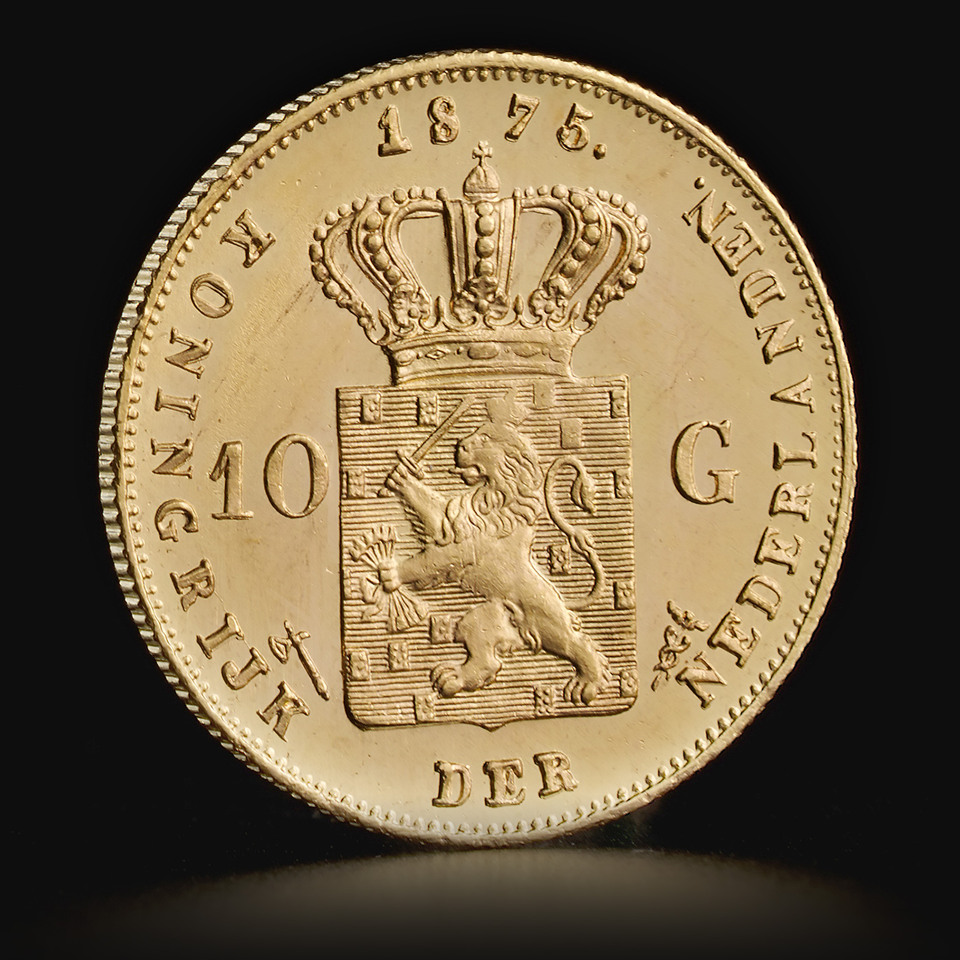
Netherlands 10 Guilder Willem III
Out of stockThe history of the Kingdom of the Netherlands and its legacy as a bellwether in global trade ... read more
We sell
We buy
-
Transaction details
This option allows you to sell gold remotely. How it works:
- Make sure you have selected the correct item.
- Complete the selling application for selling remotly.
- Follow the instructions received by email.
Warning! Make sure the products are properly packed for shipping. Tavex assumes no responsibility for loss, damage or other costs related to the package until it is received safely.
If you have any further questions, please contact us at: 0756 541 896 or rascumparare@tavex.ro

We buy
3725lei
Total expected value
3725lei
The amount displayed is estimated and is based on the data entered. The final price will be confirmed after the evaluation of the products by a Tavex specialist.
Customers rating for Tavex
Introduction
The history of the Kingdom of the Netherlands and its legacy as a bellwether in global trade is brilliantly encapsulated in this 21.6 karat 10 guilder gold coin. First struck in 1818 by the Royal Dutch Mint, its shape and design proved so successful that it hardly changed throughout its 115 years of issuance. This 10 guilder piece offered by Tavex recounts and displays the staunch royalist King Willem III and his forty-one year reign, a period of peace and prosperity that greatly raised the living standards of many Dutch citizens. Treasured and well known, the 10 guilder is a coveted classic gold coin from the Netherlands that will make a great addition to any investment portfolio.
Why Buy
- The 10 guilder is a treasured gold coin from the Netherlands. It served the Dutch people for 115 years, being an anchor of stability in turbulent times, making the coin a favourite and secure asset of many.
- The 10 guilder is both a gold investment and a collector’s item. The heritage of this coin dates back to the 14th century, recalling the Netherlands’ glorious past as one of the foremost trading countries in the world, making it suitable for any coin collection.
- The 10 guilder gold coin is the equivalent of money. It is exempt from Value Added Tax, and as such is exchangeable throughout Europe by bullion dealers and investors alike.
- The 10 guilder gold coin is the equivalent of savings. The Netherlands’ 10 guilder gold coins are an ideal choice for any long-term saver who appreciates the security and stability of owning physical gold coins.
- The 10 guilder gold coin is an excellent way to diversify your portfolio. Gold’s low correlation with other financial assets makes gold coins serve as a portfolio hedge against market risk.
History
The staunch royalist Willem III depicted on the 10 guilder gold coin
Born in 1817, Willem III succeeded his father as King of the Netherlands in 1849. With a military background, Willem was a simple man, a conservative figure that loved the army and disapproved of any limitations to royal power. Whilst he was popular with the common person, the more liberal layers of Dutch society were less fond of him.
Disregarding King Willem’s personality, what really marked his reign was the Netherlands’ rapid economic expansion from 1850 to 1900. Prior to the mid-19th century, the Netherlands had been plagued by several economic crises, epidemics and natural disasters that had left it somewhat backward compared to other countries of Europe. This, however, changed during Willem’s reign. By 1890, industrial production had almost doubled from the levels of the 1820s, and, coupled with reforms that set out to boost exports, the country became highly specialised in agricultural products – an industrial hallmark that remains to this day. In order to transport the goods, more than 2,000 km of railway track were laid, ports were built and vast canal networks were constructed. By the end of the century, the Netherlands had recaptured lost ground, so King Willem’s reign became firmly associated with a favourable period in the country’s history. Willem ruled until his death in 1890, leaving the throne to this daughter and future queen, Wilhelmina.
Throughout history, nations that successfully used their comparative advantages would expand in terms of both wealth and territory. And although the Netherlands was no different in this regard, its founding history as a maritime and colonial power began with a rather unusual, though tasty, resource: fish.
As the North Sea contained vast amounts of this resource, the Dutch became effective fishermen. In order to capitalise as much as possible on the plentiful supply, they perfected their shipbuilding techniques, leading them to build fast and sturdy freight carriers. The Dutch fluyts could carry more cargo with less crew than those of their rivals, and yet they were still cheaper to produce – a consequence of a 16th century technological breakthrough: the wind-powered sawmills which the Dutch had invented. This invention turned timber into lumber more efficiently, thus greatly reducing the cost of shipbuilding.
By 1670, the Dutch had amassed a huge merchant shipping fleet; they had more ships than Britain, France, Germany and Spain combined. As the Dutch were traders at heart, they established shipping routes to the Americas and the Far East, creating multiple colonies in the process (from which they profited immensely), whilst cementing the reputation of the Dutch Republic, as one of the world’s key commercial hubs.
Naturally, to facilitate this trade, a medium of exchange was required, prompting the Dutch to issue a large variety of gold and silver coins. Dutch ducats, stuivers, cavaliers and ducatons, to name just a few, became popular trade coinage that was spread throughout the world by the Dutch merchant fleet. The guilder, on the other hand, had a slightly different role to fulfil.
Following the establishment of the United Kingdom of the Netherlands in 1815, which incorporated all the previous Dutch provinces under one rule, the guilder was introduced to serve as the new kingdom’s official currency, a role it held until 1933. The guilder, or gulden in Dutch, meaning “golden”, was struck in denominations of 5, 10 and 20 gulden, with 10 gulden proving the most popular. In fact, besides minor tweaks made to its design (in general the same design was applied throughout its lifetime), the coin’s purity of 21.6 karats and its dimensions stayed the same for 115 years, a definite testimony to its popularity. The most issued guilders were those that depicted King William III and Queen Wilhelmina.
Product weight in grams
6.72866
Gold weight in grams
6.0558
Fineness
900
Gold weight in troy ounces
0.1947
Diameter
22
Thickness
-
Face value description
10 guilder
Manufacturer
Netherlands
Obverse
The obverse portrays the middle-aged King Willem III in an assertive posture. He is surrounded by his title “KONING WILLEM DE DERDE”, which translates as “King Willem the Third” and the motto “GOD ZIJ MET ONS”, which translates as “God is with us”.
Reverse
The reverse displays the commanding Netherlands’ coat of arms, a lion that clutches a sword and arrows in its paws, topped with the royal crown. To the left is the denomination “10” with “G” to the right. Encircling the coat of arms is the text “KONINGRIJK DER NEDERLANDEN”, which translates as “Kingdom of the Netherlands”. The year of mintage is shown at the bottom. Coins issued in 1875 display the year of mintage above the coat of arms, whilst the word "DER” is instead shown at the bottom.
Packaging
Each coin is individually packaged in a hard plastic capsule if desired.
Delivery
When you place an order through our online store, you can choose to have your products delivered by FAN Courier or to pick them up in person at one of our offices in Bucharest or Cluj.
Delivery by FAN Courier: after we have received and confirmed your payment, the products will be shipped within 24 hours. The delivery time is within 1-5 business days. FAN Courier will contact you by phone.
Pick-up from Tavex offices: you are welcome to come and collect your products at one of our offices in Bucharest or Cluj, on the same day we have received your payment.
In both cases, you must bring a valid ID to collect the products. Please note that the payer, customer and recipient must be the same person.
Insurance
The package is fully insured and, in the extremely unlikely event that the package is lost or damaged, we will resend the items or refund your money.
Packaging
Products are wrapped in protective packaging and placed in a discreet, unbranded package.
Shipment Tracking
Once the products have been packaged and dispatched, you will receive instructions and a code to track the shipment.
Delays
In the event of a delay in delivery, or if the product you ordered is out of stock, we will always contact you by email to provide you with delivery details.

Shipping Cost
Tavex provides fast, easy and secure shipping for all orders placed online. For orders with a total value of over 100 lei, shipping is free.
High stock availability
Most Tavex products are always in stock and therefore Tavex can deliver quickly and pick up on the same day at top prices on the market. Tavex is the official partner of the world’s largest mints, such as Perth Mint Australia, Austrian Mint (Münze Österreich), China Great Wall Coins Investments Ltd., PAMP Suisse and Valcambi refineries – market leaders in gold bullion production – but also of many other gold refineries and dealers.
Same-day product pickup
You can visit of our offices to benefit from a free consultation or to find out more details about a specific product. If you purchase online, you can pick up your purchased products on the same day that the payment is processed.
Low prices
Thanks to over 25 years of experience and large transaction volumes, Tavex can offer you the best prices on the market. At the same time, you can maximize your return on investment due to the low margins and spreads operated by Tavex.